
Research
The Next Frontier Seminar supports research at the intersection of technology and international affairs through our flagship year-long fellowship program and serves as a nexus for exchange across leading academic institutions civil society organizations, and private firms.
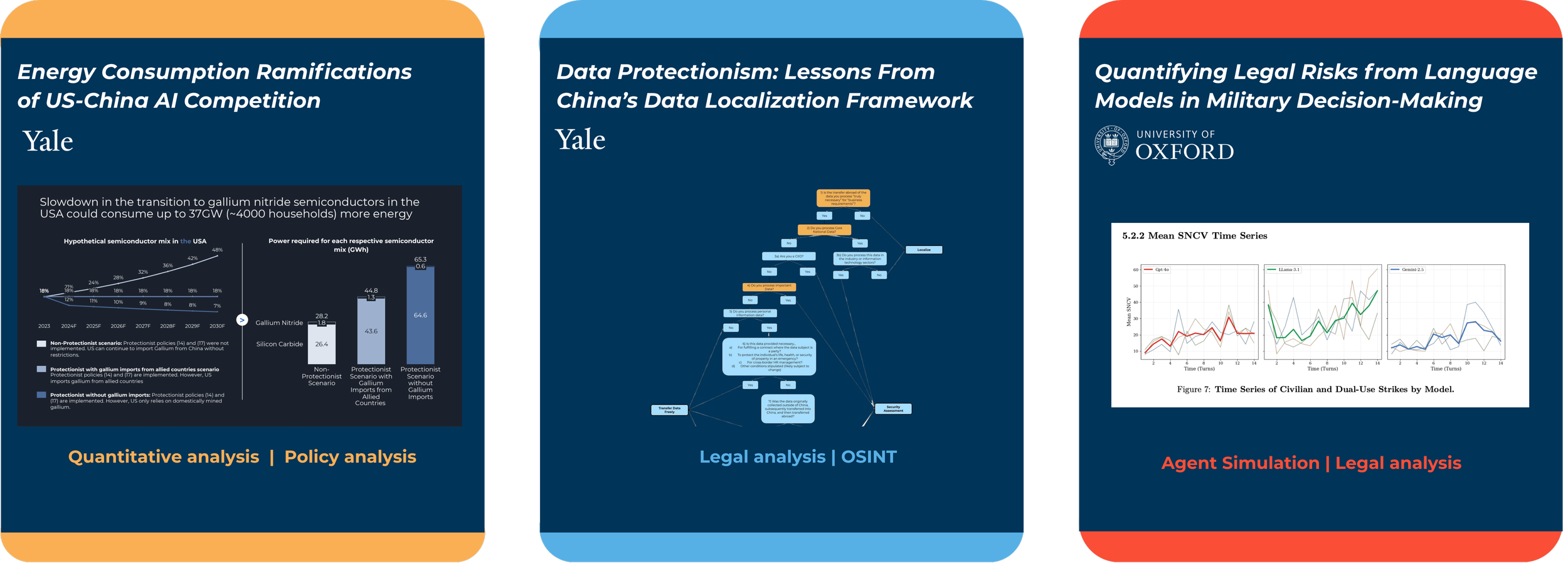
Now structured as a multi-university program based at the University of California Berkeley Risk and Security Lab (BRSL), our fellows, mentors, and collaborators have more opportunities than ever to exchange ideas and collaborate on research.
Research Areas
NFS supports research on consequential questions at the intersection of emerging technology and international affairs. We define this broadly: fellows have explored subjects ranging from artificial intelligence, semiconductors, space systems, and data infrastructure to technology governance, economic security, military strategy, and international law.
Projects may examine how new technologies alter strategic competition, how governments and institutions should manage emerging risks, or how policy can support security, innovation, and international cooperation. We encourage fellows to identify important problems, draw on the methods best suited to them, and develop research questions that reflect their own expertise and judgment. NFS explicitly encourages both cooperative and competitive framings of international affairs topics.
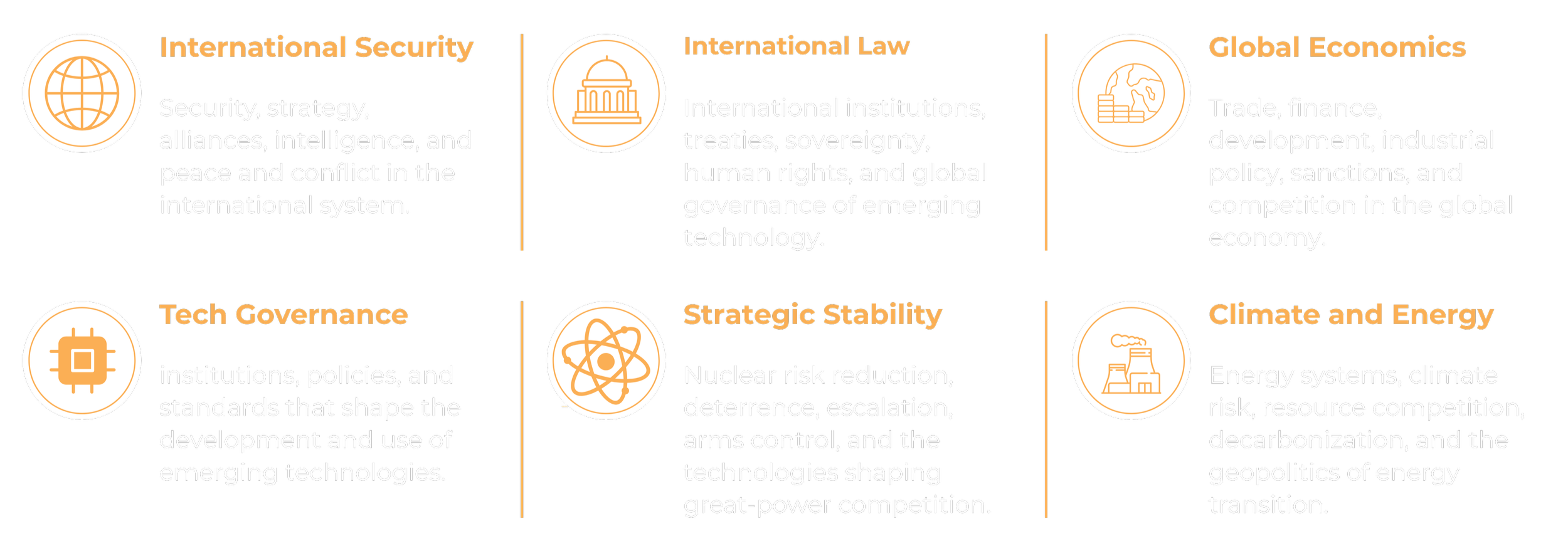
These topics provide illustrative examples - but not an exhaustive list - of topics with which NFS fellows engage.
Research Experiences and Methods
Interdisciplinary Approaches to Global Problems
NFS fellows form interdisciplinary teams and select projects informed by their interests, experiences, and mentorship from the broader NFS network. Because today’s global challenges rarely fit neatly within a single field or perspective, the program encourages fellows to engage seriously with competing ideas, methods, and approaches to technology and international affairs.
We value applicants who can contribute distinctive forms of knowledge to that process. While many fellows come from public policy, law, political science, or computer science, others bring backgrounds in the natural sciences, engineering, area studies, history, economics, ethics, or the arts. NFS teams are strongest when technical, regional, strategic, and human perspectives are brought into conversation on a topic of genuine interest to the fellows undertaking it. Fellows are not expected to arrive with identical training. With support of the program, fellows work across disciplines and use the combined strengths of the team to develop more rigorous and original work.
Methodological Variety
NFS supports a variety of methodological approaches and encourages fellows to select research methods appropriate for their topic of interest. Past fellows have combined legal and policy analysis with technical modeling, comparative case studies, supply-chain research, regional analysis, expert consultation, and data-driven assessment. Some projects are primarily qualitative, others quantitative or computational, and many draw on several approaches at once.
The NFS fellowship provides structured research methods training intended to orient fellows to a variety of approaches and provides opportunities for further mentored study. Mentors and experts help teams strengthen their research design, test assumptions, and connect disciplinary methods to practical questions in technology and international affairs. This flexible structure allows us to accommodate a variety of methodological approaches and suit the needs of fellows at different stages of academic progress.
Research Community
NFS brings fellows into a wider research community shaped by exchange across partner universities, proximity to leading research institutes, and sustained engagement with experts across academia, government, industry, and civil society. Together, these connections expose fellows to a broad range of ideas, methods, and professional perspectives.
The Next Frontier Seminar offers a rich research community beyond the fellowship cohort. Now structured as a multi-university program based at the University of California Berkeley Risk and Security Lab (BRSL), the program brings fellows into contact with leading technology policy research institutions and the technical communities they engage with. NFS fellows have engaged with experts across the Schmidt Program on Artificial Intelligence at Yale, Stanford’s Hoover Institution, the Oxford Internet Institute, military doctrine development centers, and leading private firms. This enriches the experience of our fellows and facilitates exchange between partner institution researchers.


The NFS Fellowship is now a multi-university program based at the University of California, Berkeley Risk and Security Lab (BRSL).
Exchange with Fellows from Peer Universities
NFS fellows are part of a wider inter-university cohort that extends beyond heir home university. Through in person retreats, colloquia, workshops, and informal gatherings, fellows exchange ideas with peers from other partner institutions, compare approaches, and learn from different academic cultures and traditions.
These interactions broaden the intellectual range of each project. Fellows encounter new methods, assumptions, and areas of expertise, while building relationships with peers who share an interest in technology and international affairs. The result is a network that extends beyond any single campus and often continues well beyond the fellowship year.